
Phone case manufacturing lead time is the time needed to move a defined order through its agreed production stages. It is not automatically the time from your first message to delivery. An available case, a branded version of an existing platform and a new molded structure have different schedules. Sample development, buyer approval, production readiness, bulk manufacture and freight should therefore be dated separately.
For a dependable launch plan, ask for a schedule tied to the exact phone models, quantities, finish and packaging. Kejie can review your product reference and customization brief through its OEM and ODM project service. Start with the required arrival date so the discussion covers both factory dispatch and transport.
Discuss your phone case production schedule
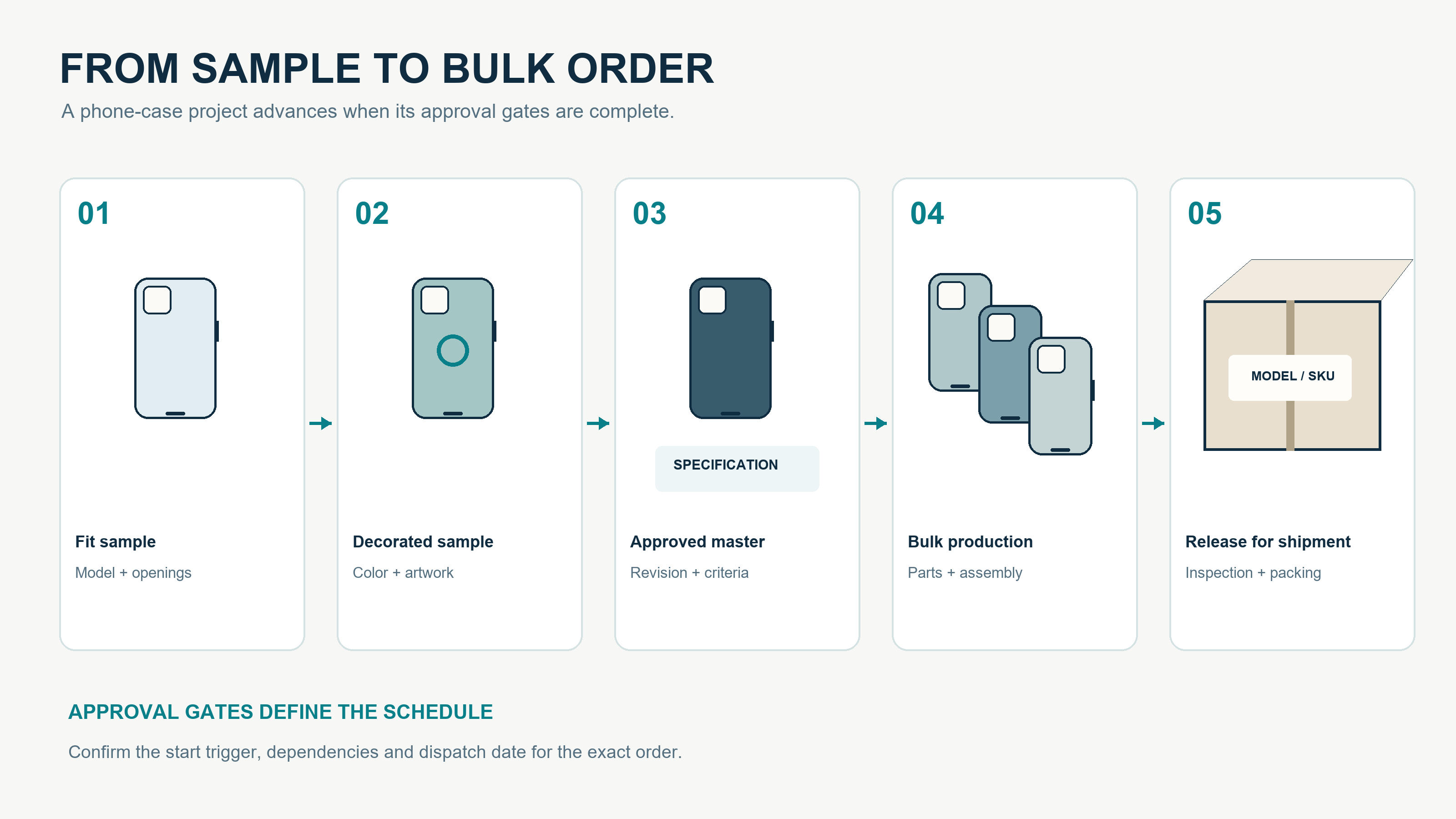
- Fit sample: confirm model and openings.
- Decorated sample: confirm color and artwork.
- Approved master: confirm the sample version and acceptance criteria.
- Bulk production: coordinate parts and assembly.
- Shipment release: complete inspection and packing.
Ask for the earliest dispatch date, not only a day count
Give Kejie your required arrival date and ask for separate sample, approval, production, inspection and dispatch milestones. Mark artwork and packaging deadlines and the party responsible for each approval. If the required arrival cannot be supported, compare a confirmed standard configuration with a custom version; do not remove inspection or assume faster freight resolves unfinished production.
How long does phone case manufacturing take?
The useful answer is a route-specific quotation. Stock availability can shorten an order, while a new mold or an unresolved fit issue adds development before bulk production can begin. A quoted production duration only becomes meaningful when its start trigger, included operations and dispatch milestone are clear.
| Order route | What must be confirmed | Schedule implication |
|---|---|---|
| Available standard cases | Exact model/color stock, quantity and standard packing | Confirm allocation and dispatch; do not assume every pictured variant is available. |
| Existing case with branding | Artwork, logo position, color/finish and packaging approval | Add decoration and sample approvals to the chosen platform’s schedule. |
| New shape or functional structure | Drawing, tooling, trial parts and production-intent approval | Plan development separately before booking the bulk-production window. |
| Repeat order | Same approved revision, components, artwork and packaging | Reconfirm capacity and materials; a repeat SKU is not an automatic stock promise. |
Read published timing at the product level
Kejie’s matte magnetic TPU + PC case lists approximately 3–7 business days, subject to stock, quantity and customization. The PU leather wallet case references approximately 10–20 days depending on the order. These are product-specific references, not sample-to-delivery promises. The wallet reference does not establish whether days are calendar or working days; confirm that in the written quote.
Ask which operations those figures include and when the clock starts. A new structure, custom color or packaging change needs its own confirmed schedule rather than an extension guessed from these references.
From a sample request to bulk-production approval
Sample lead time ends at sample readiness or dispatch; approval lead time includes review and any revisions. A stock sample can help compare fit and feel, but it may not represent your final logo, color, magnetic assembly or retail pack. Separate those decisions so “sample approved” has an exact meaning.
| Approval gate | Buyer check | Release record |
|---|---|---|
| Fit and structure | Exact device, buttons, camera and connector openings; moving parts if fitted | Sample ID, model and drawing/structure revision |
| Finish and function | Color reference, artwork position, accessory combination and agreed checks | Dated decorated sample and listed exceptions |
| Packaging | Model label, artwork language, barcode and packing configuration | Approved artwork/pack revision |
| Production release | No unresolved critical issues; materials, order and agreed payment conditions ready | Approved reference set and written production start trigger |
Keep one consolidated feedback list with photos, affected sample IDs and the required correction. If several reviewers approve different files, production can start from the wrong version even when every email says “approved.” The Galaxy case sourcing guide shows how model-specific approval and SKU records support a repeatable order.
Build a schedule with dates, owners and release conditions
Use the following as a planning sheet. Request a duration and target date for each applicable stage, including who must release it. Existing molds may omit tooling development; custom structures should not hide it inside a vague sampling estimate.
| Stage | Start only after… | Record in the schedule |
|---|---|---|
| Brief and route review | Model list, quantities and change scope are supplied | Open questions, owner and scope-freeze date |
| Tooling, if needed | Design and tooling responsibilities are agreed | Tool completion, trial parts and revision allowance |
| Sample and review | Selected components and artwork are ready | Sample dispatch, review window and revision deadline |
| Production readiness | Approved specification and agreed commercial conditions are complete | Material/pack readiness and booked capacity |
| Bulk work | Production release is issued | Molding/parts, finishing, assembly and completion date |
| Inspection and packing | Production is complete and criteria are available | Inspection slot, corrective-action allowance and carton data |
| Dispatch and delivery | Release documents, booking and payment conditions are satisfied | Pickup, transit, clearance and destination receipt |
Use a sentence such as: “The quoted period starts after the approved specification, required materials and agreed deposit are received, and ends when the order is ready for carrier pickup.” Adapt it to the actual agreement. Confirm working days, holidays, cutoff times and whether inspection, packing or freight is included.
Confirm these details before accepting a dispatch date
- Day-count basis: working or calendar days, applicable holidays and the agreed start event.
- SKU allocation: quantities by phone model and color, not only an order total.
- Included work: sample revisions, decoration, assembly, inspection and packing; identify anything quoted separately.
- Buyer deadlines: artwork, sample feedback and packaging approval dates needed to hold the schedule.
- Shipment milestone: distinguish goods ready for pickup, carrier departure and destination receipt.
If the specification changes after approval, request an updated schedule before accepting the change. Identify the affected SKUs, additional work, revised dispatch milestone and whether unchanged items can proceed separately. Treat a planning estimate as provisional until its dependencies and production slot are confirmed.
Separate an estimate from a confirmed production schedule
An early estimate helps compare sourcing routes. A confirmed schedule should identify the approved product revision, quantities by SKU, required inputs, production slot and dated milestones. Ask which items remain conditional and who must resolve them. Do not treat an initial sales estimate as an unconditional arrival commitment.
- Before approval: record the estimate, assumptions and unresolved sample or artwork decisions.
- At production release: request a dated schedule tied to the approved specification and agreed start conditions.
- During production: track milestone completion and report changes against the same schedule revision.
- Before dispatch: confirm inspection release, carton information and the carrier booking separately from factory completion.
For a branded range, use the private-label sourcing guide to coordinate case, artwork and packaging approvals. For magnetic variants, compare the magnetic case collection and specify the accessory combination before agreeing the sample scope.
Parallel work can shorten the schedule, but dependencies still matter
Some tasks can overlap once their inputs are fixed. For example, approved packaging and material procurement may progress together. Manufacturing cannot safely start merely because one branch is ready; the limiting dependency determines the release date.
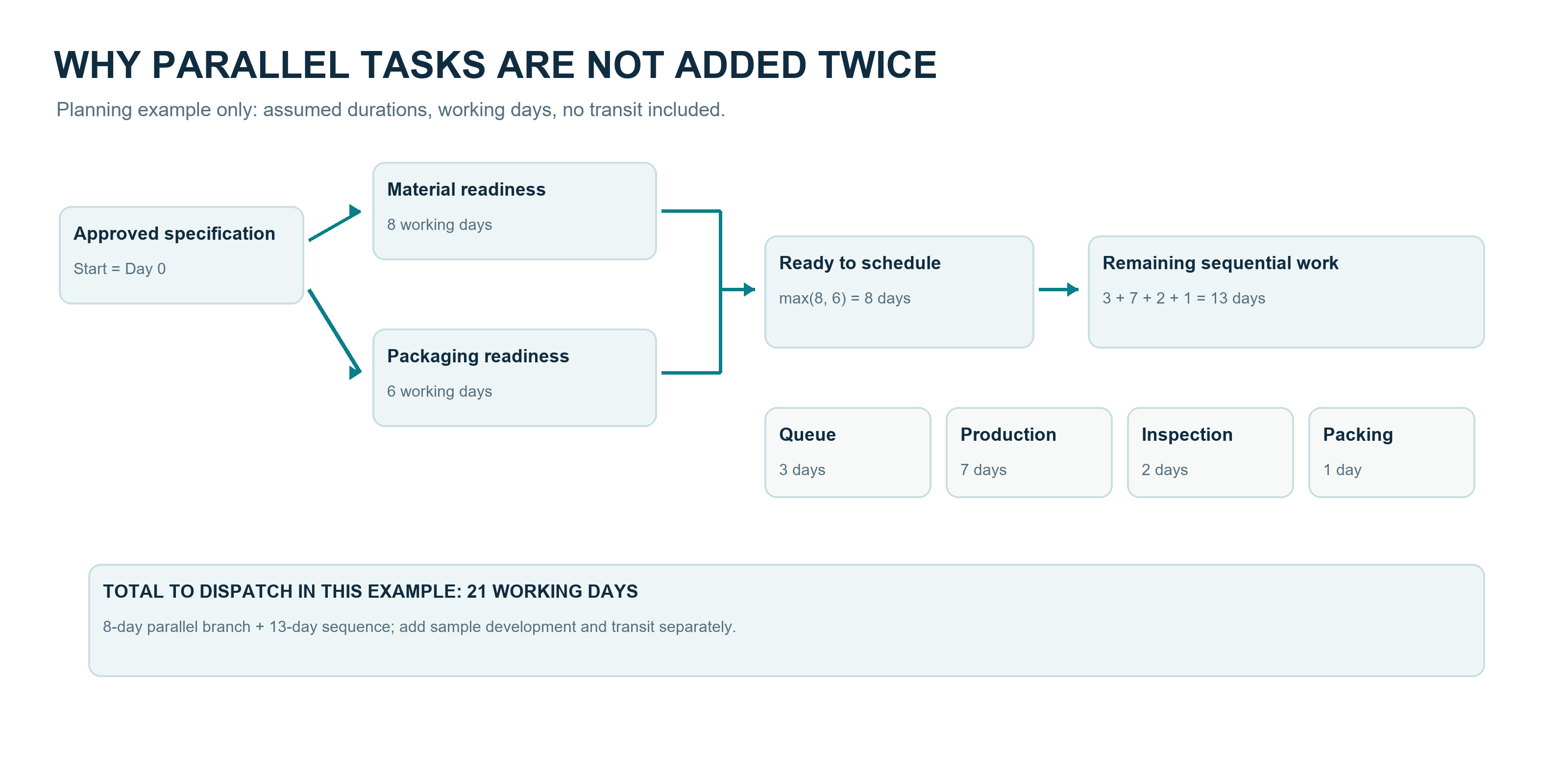
After specification approval, materials take 8 working days and packaging takes 6. If both start together, readiness is reached after 8 days.
Then add queue 3 + production 7 + inspection 2 + packing 1 = 13 days.
Example total: 21 working days to dispatch. Assumed durations; tooling, sampling and transit are separate.
Example to dispatch = max(material readiness 8, packaging readiness 6) + queue 3 + production 7 + inspection 2 + packing 1 = 21 working days.
This is an arithmetic planning example with assumed durations, not a Kejie quotation. It begins after specification approval and excludes sample development, tooling, revisions, holidays and transit. It applies only when both readiness tasks truly run in parallel and inspection and packing occur afterward. If a packaging approval is late or inspection requires rework, the path changes.
For your order, replace each assumption with a confirmed duration and dependency. Ask which task is currently holding the earliest possible dispatch date instead of adding every department’s estimate together.
What increases phone case manufacturing lead time?
| Change or constraint | Why it affects timing | Useful prevention |
|---|---|---|
| Model or structure changes | A revised opening, button or mechanism may require tooling and fit review | Freeze the exact device and revision before release. |
| New finish or artwork | Color matching, registration and durability may need another sample | Send final artwork and a physical color reference where needed. |
| Magnetic or stand components | Parts availability and assembly/function checks create dependencies | Approve the exact component/accessory combination. |
| Too many model/color splits | Each variant can need separate allocation, setup or labeling | Send quantities by SKU rather than one total. |
| Custom retail packaging | Artwork, printing and model labels may become the limiting branch | Approve pack files while case development is progressing. |
| Late inspection changes | New criteria or corrective work can postpone release | Agree checks and defect limits before production. |
Quantity alone does not explain timing. A repeat configuration with approved materials can be easier to schedule than a smaller order with many new combinations. Confirm the available production slot, material readiness and all finishing operations before committing to a launch.
To shorten a project, remove unnecessary changes, approve consolidated feedback promptly and ask about an existing product platform. If needed, discuss a smaller first allocation or split shipment with Kejie; feasibility, added freight and inspection arrangements require confirmation. Do not remove essential fit or functional checks to make a promised date look achievable.
Start the timing discussion from a concrete Kejie product
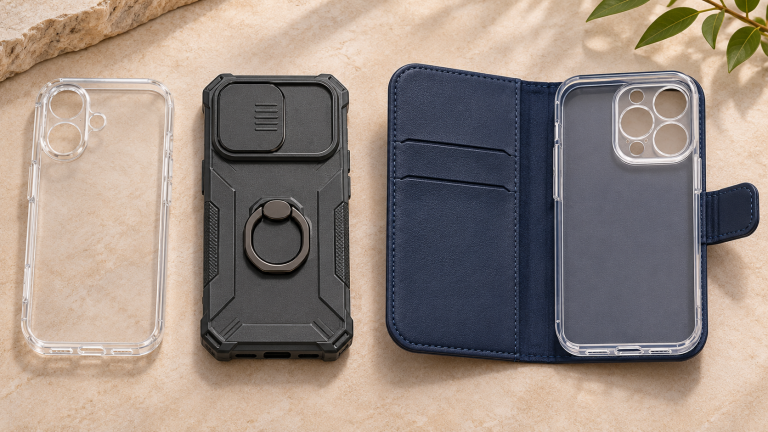
These published products provide different starting points for a schedule review. Choose the closest construction first, then specify what stays standard and what changes. Their pictured versions do not establish current stock or a universal lead time.

Matte TPU case
A solid-color platform for discussing standard variants, branding and custom colors. Confirm which requested versions are available.

Magnetic TPU + PC case
A composite platform where magnet configuration, finish and accessory checks should be included in the approval brief.

PU leather wallet case
A layered wallet construction where closure, inner-shell fit, finish and packaging need coordinated confirmation.
Work backward from the required arrival date
A launch date is an arrival requirement, not a factory-finish date. Keep dispatch, transport, customs clearance and warehouse receiving separate. Ask your carrier or forwarder for the route-specific transit plan; an air or sea estimate is not a guarantee of delivery.
- Set the destination milestone: record when inventory must be received and ready for sale.
- Deduct logistics and receiving time: include the selected transport route, clearance and your warehouse process.
- Set the latest factory dispatch: then allow for inspection, corrective work and packing.
- Set the latest production release: work back through the booked production and readiness stages.
- Protect approval time: allow sample transit, review and any justified revisions before that release date.
Separate a repeat-order forecast from the confirmed purchase order. Share the launch deadline early and ask Kejie to identify unresolved dependencies and the next decision needed. A transparent conditional date is more useful than an unsupported “fast delivery” promise.
Request a project-specific timeline from Kejie
Kejie’s sample-led OEM/ODM process connects product selection, controlled revisions and production coordination. Send one complete brief so our team can review the appropriate product route and the milestones that need confirmation.
- Exact phone models and quantity per model/color.
- Product link or reference image; standard configuration versus requested changes.
- Material, finish, logo/artwork, magnetic or stand requirements.
- Packaging files and model-label requirements.
- Sample approval criteria, destination and required arrival date.
Ask for sample readiness, approval cutoff, production start, inspection and dispatch dates, with the start conditions and day-count basis written into the response.
Phone case lead-time questions
Does sample lead time include delivery and buyer approval?
Only if the quotation says so. Confirm whether it ends at sample completion, dispatch or receipt. Buyer review and revision loops should have their own milestones.
Can bulk production start before the final sample is approved?
Some preparation may be possible, but starting irreversible work with unresolved fit, artwork or functional issues creates rework risk. Agree which activities may proceed and what remains on hold.
Will a reorder always take less time?
It may avoid development if the approved revision is unchanged. Material supply, stock allocation and capacity still need checking. A changed finish, component or packaging can require renewed approval.
How should a delay be communicated?
Identify the affected milestone, cause, remaining dependency, corrective action and revised dispatch date. Record whether the arrival target is still achievable before approving an expedite or split shipment.
Further manufacturing context: service-specific molding and secondary-operation schedules illustrate why finishing and assembly must be scoped separately. Those supplier figures are not Kejie lead times.

 English
 Español de Argentina
 Русский
 Italiano
 日本語
 한국어
 العربية
 Français
 Deutsch