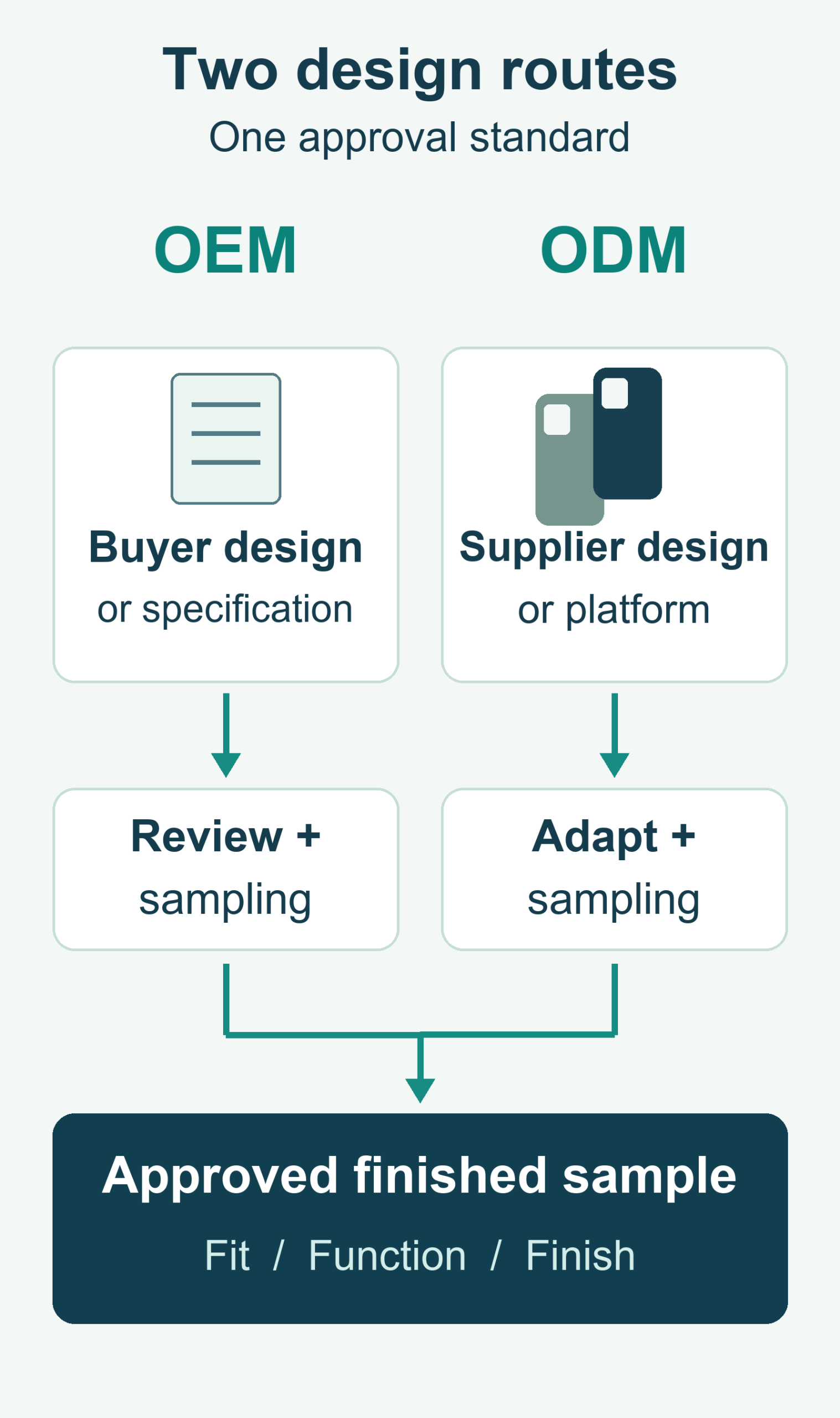
The main difference between OEM and ODM phone cases is where the product design starts. In a typical OEM project, the buyer brings a design or specification for the manufacturer to execute. In an ODM project, the supplier provides the design platform or development work, which the buyer can adapt for a branded range.
For a phone-case buyer, the practical question is what needs to change: only the logo and packaging, the appearance of an existing shell, or the structure itself. Choose the route around that scope. An OEM or ODM label alone does not tell you the project’s price, ownership terms, minimum order or finished-case performance.
Not sure which route fits your range? Kejie supports both buyer-defined projects and existing-platform adaptation. Send a reference product or drawing plus your required changes, and ask for a focused project review.
What do OEM and ODM mean in phone-case sourcing?
OEM: buyer-defined design
- Meaning
- Original Equipment Manufacturer. In this sourcing route, you provide the design/specification; the supplier reviews and executes it.
- Starting file
- Drawing, approved reference or annotated sample with exact changes.
- Before release
- Agree manufacturability revisions, material, tooling and sample criteria.
ODM: supplier design work
- Meaning
- Original Design Manufacturer. The supplier provides the design/platform or undertakes development.
- Starting brief
- An existing platform and adaptations, or a supplier-led design brief.
- Before release
- Confirm design deliverables, allowed changes and finished sample. ODM can involve new design work, not only catalog branding.
Kejie’s OEM and ODM service supports buyer-specification execution and existing-platform adaptation. Confirm the actual work in your quotation.
What are the key differences between OEM and ODM phone cases?
Typical arrangements are shown below. Confirm exceptions when your artwork, supplier tooling and new design work are combined.
| Decision | Typical OEM route | Typical ODM route |
|---|---|---|
| Starting point | Your defined design, specification or reference with changes | A supplier-designed platform or a supplier-led development brief |
| Design work | Manufacturability review and execution of the agreed buyer specification | Platform selection, adaptation or further supplier design work |
| Tooling | Existing tooling may fit; a distinct structure may require new or modified tools | A usable platform may reuse tooling; structural changes still require review |
| Differentiation | Can be built into a buyer-defined geometry or function | Can come from finish, artwork, packaging and agreed platform modifications |
| Budget and schedule | Depend on engineering, tooling, revisions and order configuration | Depend on reusable work, customization, availability and order configuration |
| Rights and exclusivity | Define them for the relevant drawings, tools and new work | Define them for the base platform, changes and brand assets |
| Release requirement | Approve the finished case against the agreed specification | Approve the finished case against the agreed specification |
Which route should your brand choose?
The existing shell already works
- Route
- Platform adaptation for logo, colors, print or packaging.
- Ask Kejie
- Which branding options and finished-sample checks apply? New geometry is a separate task.
The required structure is missing
- Route
- Design and tooling review.
- Ask Kejie
- Can the platform support the changed button, camera surround, stand interface or profile? Supply dimensions and why it must change.
You have an idea, not drawings
- Route
- Shortlist platforms before committing to original development.
- Ask Kejie
- Which designs meet the exact phone list and non-negotiable functions? If none does, define supplier-led development deliverables.
Two Kejie platforms to start the discussion
These are references for their stated iPhone 17 Series versions; confirm the exact model and customization scope.
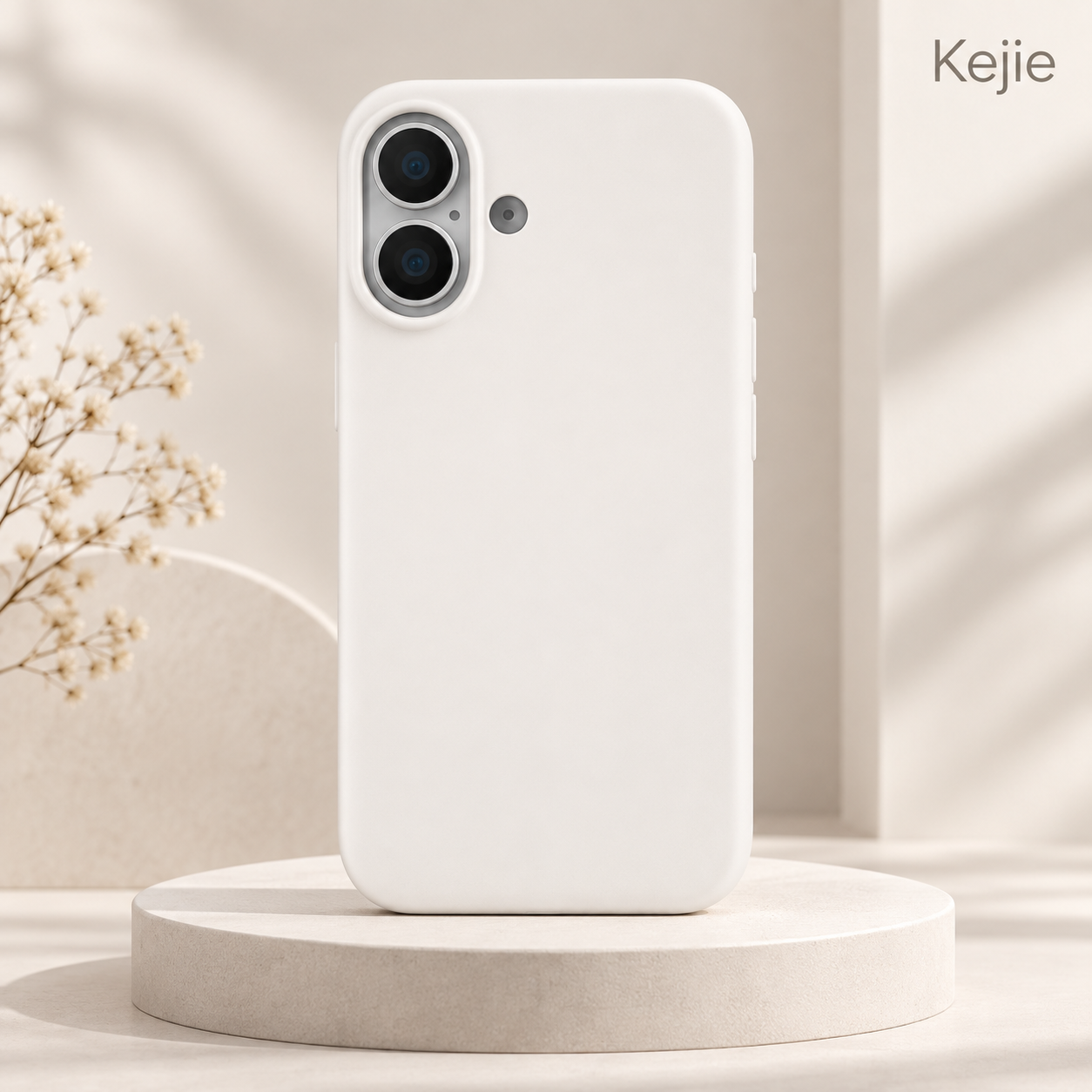
Liquid silicone: define the branding scope
- Product: Liquid silicone · iPhone 17 Series.
- Use: Soft-touch, logo-led collection.
- Confirm: Exact model/color, logo method, finish and packaging; new shell geometry is separate.
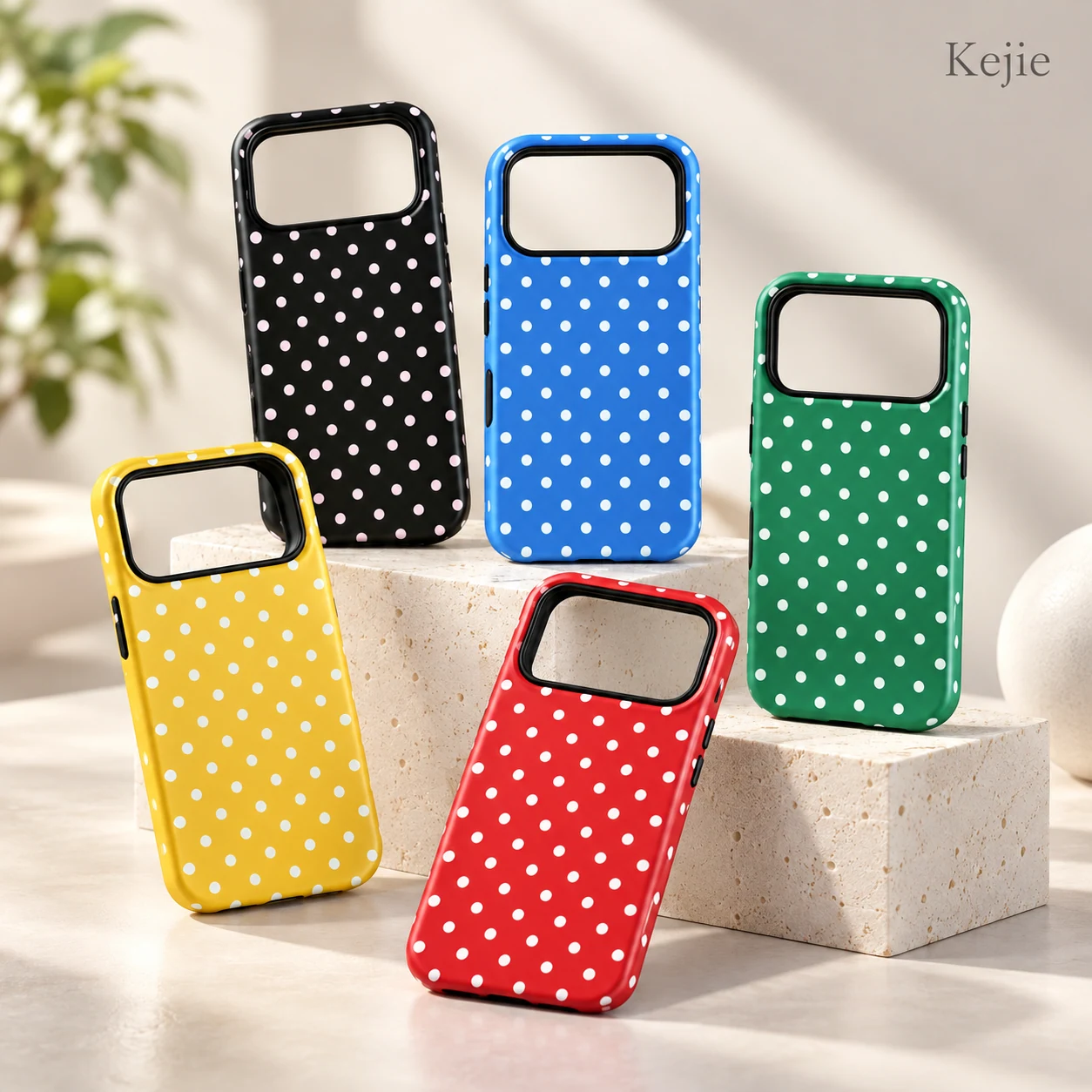
Printed TPU + PC: adapt a visual range
- Product: Printed magnetic TPU + PC · iPhone 17 Series.
- Use: Artwork-led private-label range.
- Confirm: Artwork around openings/edges, finish, model and packaging; structure changes need review.
For a broader hybrid-shell shortlist, browse Kejie’s TPU + PC phone case collection. Select a specific platform before asking which modifications it can support.
Does adding a logo make a phone case OEM?
A logo alone does not identify the development route. Suppliers use the labels differently. State whether you are branding an existing design or changing the product, then use the checks below.
| Requested change | What to establish | What to review on the sample |
|---|---|---|
| Logo or repeat artwork | Application method, position, artwork revision and color target | Placement, coverage around openings and visible surface finish |
| New color or finish | Material/finish option and the approved reference | Appearance, handling and consistency across matching parts |
| Different material | Whether the structure and process can accommodate the change | Fit, profile, handling and the resulting assembly |
| New phone variant | Exact version and whether matching tooling exists | Camera openings, buttons, ports and fit on that device |
| New stand or magnetic layout | Space, assembly, interfaces and agreed functional checks | The intended case/device/accessory combination |
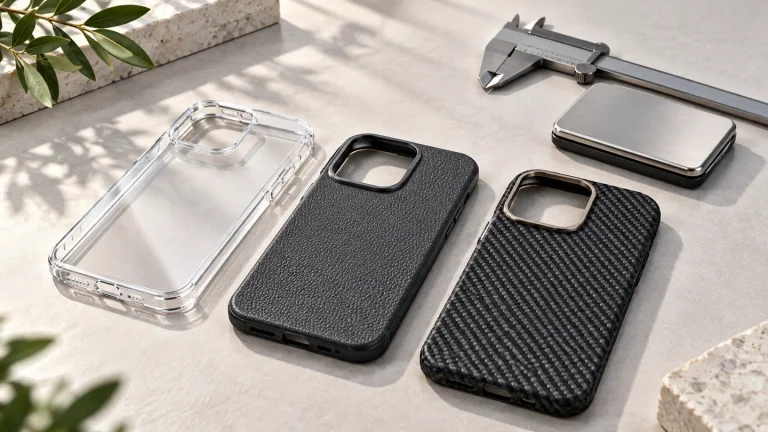
A material change deserves more than a catalog rename. If your premium brief involves a woven construction, the aramid fiber materials and sourcing guide explains the sample questions to add. Carry those requirements into the project specification instead of treating material choice as proof of finished-case performance.
Is ODM cheaper, faster or available at a lower MOQ?
ODM may save development when suitable design/tooling can be reused; it is not always cheaper or faster. A complex adaptation may need more work than an approved OEM repeat order.
- One-off work
- Design review, tooling/modification, artwork setup and samples where needed.
- Recurring order
- Case, decoration, assembly and the specified pack.
- Quantity split
- Each model, color, artwork and packaging version—not one total.
- Schedule trigger
- Complete files, sample approval, payment or material availability? Separate sample and bulk stages.
- Scope changes
- Ask what changes if you reuse tooling, simplify artwork or develop new geometry.
A standard-product minimum does not automatically cover custom branding or a new mold. Send Kejie the same configuration and order split when comparing routes.
Does OEM mean you own the design, mold or exclusive selling rights?
Do not infer ownership or exclusivity from “OEM.” WIPO’s supplier-IP guidance recommends clarifying ownership, use and confidentiality in writing.
- Existing assets: What platform, process or drawings does each side bring?
- New work: Who controls the resulting drawings, improvements, tools and artwork?
- Use/exclusivity: Which products, markets and permitted uses are agreed?
- Confidentiality/handover: Kejie offers an NDA discussion. Set the route before sharing sensitive files and define deliverables separately from sample approval.
Payment for a sample, tooling or development is not a substitute for a clear description of the agreed rights.
Does either route guarantee better quality?
Neither route is a quality grade. Both need an approved finished configuration; material, print, mechanism or model changes can require rechecking.
- Fit the exact phoneReview camera, buttons, ports, installation and retention.
- Review finish and functionsMatch color/artwork to the reference. Check the named magnetic accessory or stand combination.
- Match the evidenceUse agreed evidence for any protection or charging claim; the route name proves neither.
- Record and recheck changesTie the retained sample to the specification/artwork/pack revision. Correct a failing fit before bulk approval; a successful logo proof does not fix geometry.
How do you start the right project with Kejie?
Send the product goal and required changes first. Kejie can help scope the route.
You have a design
- Send
- Exact device versions, current drawing/annotated sample, material/functions, order split and branding/pack.
- Mark
- Essential dimensions versus details open to manufacturability review.
You need a platform
- Send
- Customer/channel, device list, product reference, essential functions, visual direction, order split and delivery target.
- Ask
- Suitable platforms and which modifications require development.
Add sample criteria and confidentiality/exclusivity questions so the quotation addresses the same brief.
 English
 Español de Argentina
 Русский
 Italiano
 日本語
 한국어
 العربية
 Français
 Deutsch