
Selection principle: choose the manufacturer that can prove how it controls foldable geometry, sample revisions, quality and change — not the one with the longest catalog or the lowest first quote.
A foldable iPhone case manufacturer has a harder job than a supplier making a conventional one-piece shell. Apple’s iPhone Duo is 5.2 mm deep when open, 11.3 mm when folded, weighs 254 g, and uses two displays connected by a precision hinge. Apple’s own Duo Case is a two-part design, while its Duo Folio adds a kickstand and magnetic charging around the same moving form factor. Those details turn supplier selection into an engineering and process-control decision, not just a price comparison.
Use the following tutorial as a supplier-screening workbook. The goal is not to find a factory that says “yes” to every request. The goal is to find one that can show evidence, define limits, build a repeatable sample process and tell you exactly what will change between prototype and mass production.
ASK FOR EVIDENCE
DFM screenshots, revisioned drawings, physical samples, sample IDs, inspection plans, test records, material lots and packaging proofs.
DO NOT ACCEPT AS PROOF
A beautiful product render, a generic “OEM/ODM” badge, a certificate screenshot with no scope, or a promise that “we can customize anything.”
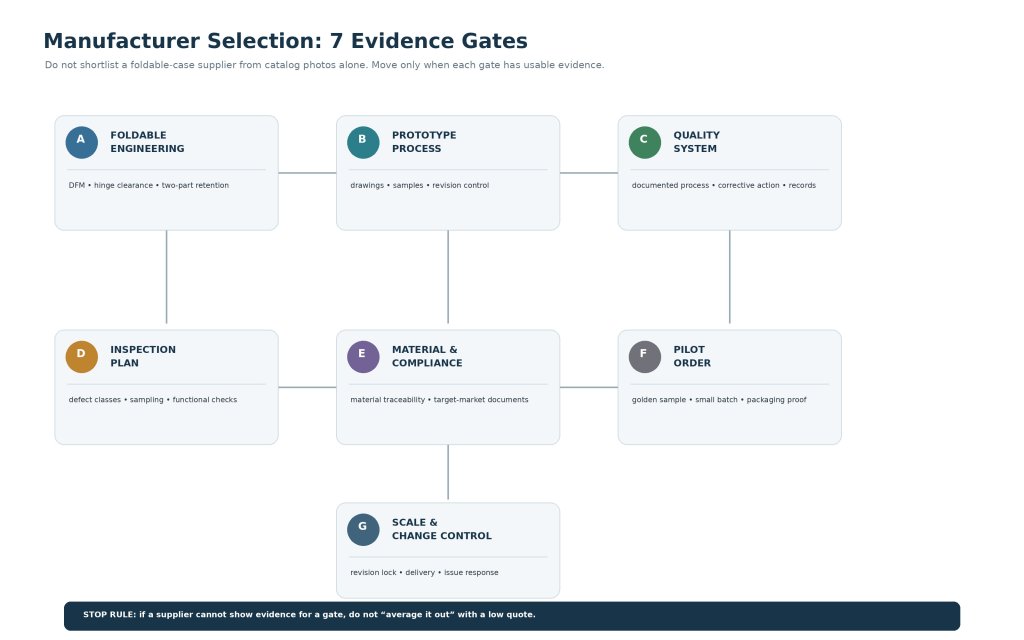
CHECK 1: FOLDABLE CASE DESIGN
Can the supplier engineer a moving product, not just copy a shell?
Start with foldable-specific engineering evidence. Apple describes iPhone Duo as a two-part foldable system with a precision hinge and publishes different open and folded dimensions. A supplier should therefore be able to discuss the complete fold path, front-shell retention, hinge clearance, shell-to-shell interference, open-state alignment and accessory loads.
Ask for a foldable DFM review rather than a generic CAD screenshot. A useful review should identify where the front shell attaches, what happens at intermediate fold angles, how the hinge stays clear, which surfaces can tolerate pressure, and which dimensions are critical to function.
Fast screen-out: if the supplier can only discuss the phone when fully open and fully closed, but cannot explain the 30°–150° transition range, the engineering review is incomplete.
Device references: Apple — iPhone Duo Technical Specifications, Apple — iPhone Duo Case, and Apple — iPhone Duo Folio with Kickstand.
CHECK 2: SAMPLE VERSIONS AND CHANGES
Can they show how a first sample becomes a production sample?
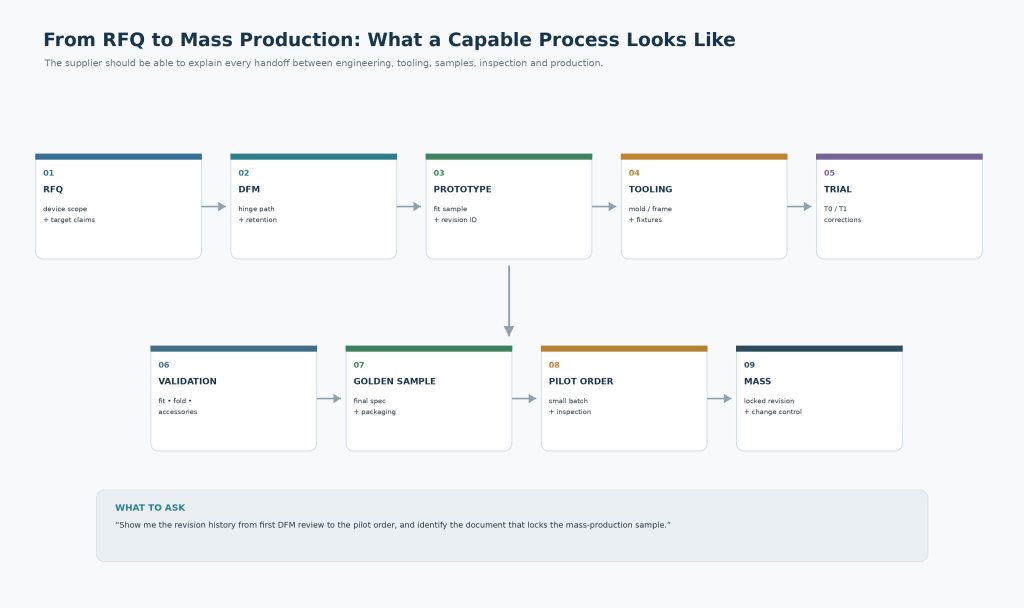
A strong manufacturer should be able to reconstruct the development path. That means the first DFM review, the first prototype, tooling corrections, fit revisions, functional changes, golden sample and pilot lot each have an identity. “The sample is better now” is not revision control.
Ask for the revision history of one comparable project. You do not need another customer’s confidential drawing; you do need to see how the supplier labels revisions, closes problems and prevents an old mold insert, magnet layout, adhesive, hinge component or packaging file from returning to production.
CHECK 3: QUALITY CONTROL PROCESS
Look for a controlled process, not a certificate-shaped shortcut
ISO 9001:2026 is a globally recognized quality-management standard covering controlled processes, documented information, performance evaluation and continual improvement. A valid ISO 9001 certificate can be useful evidence that a manufacturer operates a formal quality-management system, but the certificate does not prove that a specific foldable case is well engineered.
Use certification as one layer of evidence. Then ask how the supplier applies its system to your product: Who releases drawings? Who approves the golden sample? How are nonconformities recorded? Which changes require buyer approval? Can the factory show corrective-action records from a product problem?
Authority reference: ISO 9001:2026 — Quality management systems — Requirements.
CHECK 4: INSPECTION AND FUNCTION TESTS
“AQL 2.5” is not an inspection plan
ISO 2859-1:2026 provides AQL-indexed sampling schemes for lot-by-lot inspection by attributes. That makes it a useful framework for final inspection, but the number alone does not define what matters. The buyer still needs defect classes, inspection items, functional tests and acceptance criteria.
For a foldable case, separate appearance from function. Cosmetic marks may be sampled. Hinge interference, front-shell retention, button obstruction or a wrong model label may require tighter treatment. Decide which checks are sampled and which are 100% inspection before the pilot order, not after defects appear.
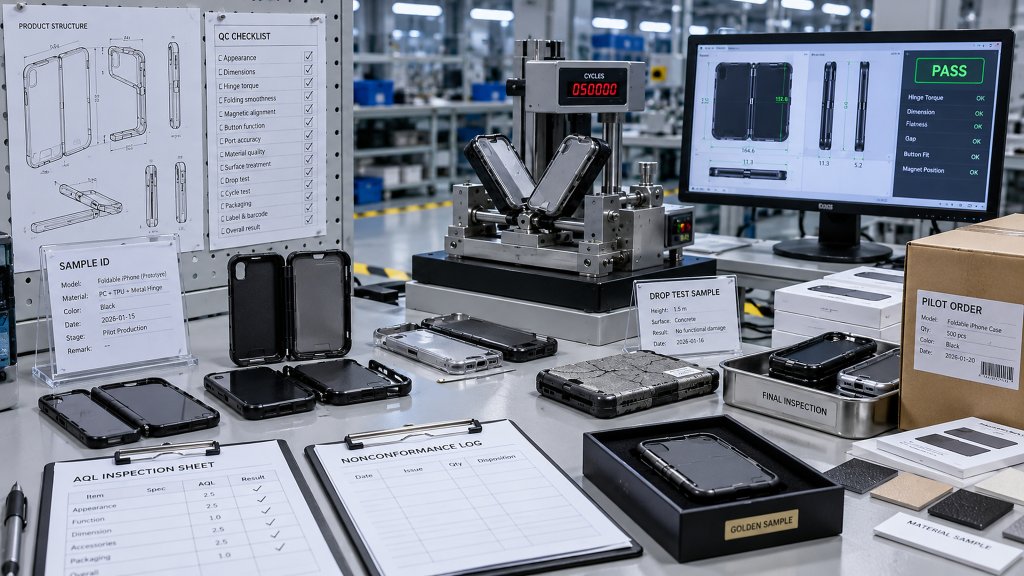
Sampling reference: ISO 2859-1:2026 — Sampling procedures for inspection by attributes.
CHECK 5: MATERIALS, ACCESSORIES AND COMPLIANCE
Can the manufacturer trace the parts that actually affect foldable performance?
Foldable cases often combine several materials and functional parts: rigid shells, flexible edge material, internal pads, magnets, hinge-related components, adhesives, coatings and packaging. The supplier should be able to identify the material source or lot for the parts that affect fit, retention, surface durability and accessory behavior.
Ask how substitutions are controlled. A different adhesive, magnet, TPU hardness, PC grade, coating or metal part can change the product even when the external drawing is unchanged. Target-market compliance documentation should also match the actual materials and decoration used in the finished order; do not accept an unrelated report from a similar case.
CHECK 6: TRIAL PRODUCTION ORDER
Run the production process before you run production volume
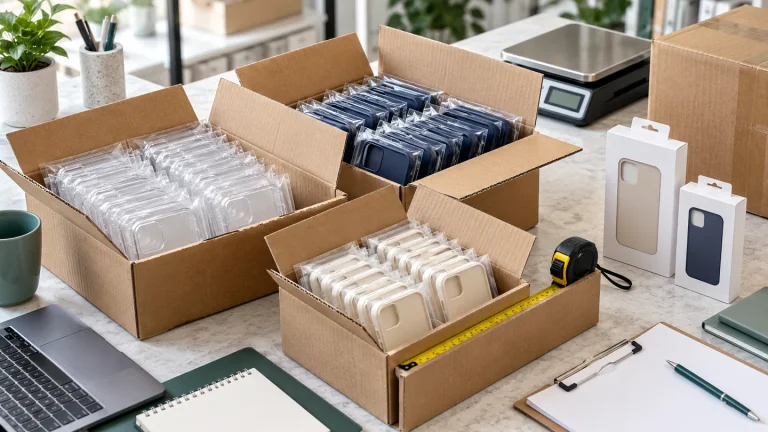
A pilot order is where procurement learns whether the supplier can repeat the approved sample under production conditions. The pilot should use production-intent tooling, materials, magnetic components, packaging and inspection records. It should not be a hand-built showroom sample prepared by the engineering team.
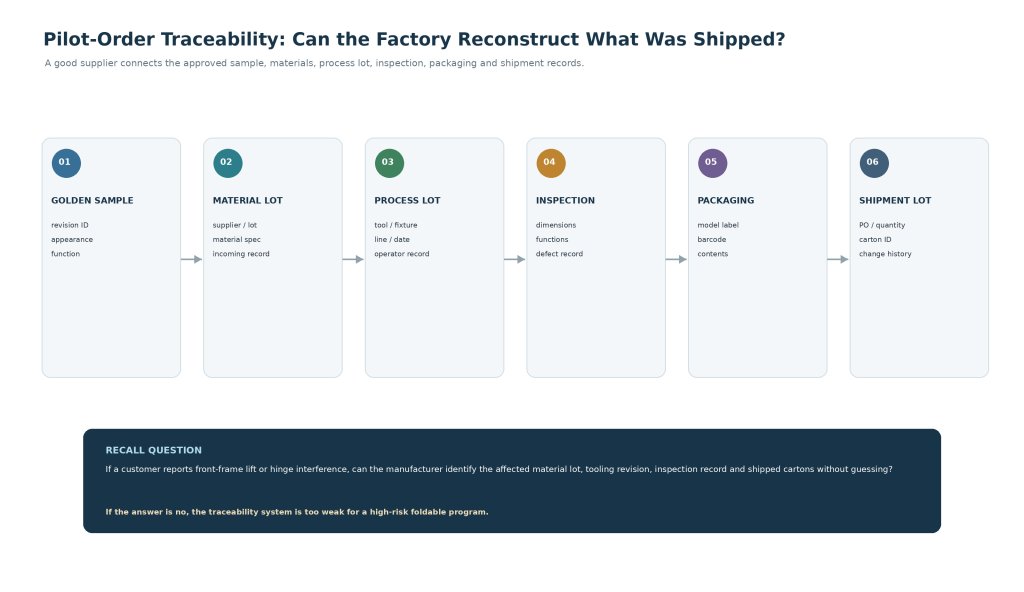
Preserve a signed or otherwise controlled golden sample and connect it to the final drawing/specification. Then compare the pilot lot with that reference. If the pilot exposes front-frame lift, unstable hinge clearance, color variation, magnet-position drift, packaging errors or inconsistent stand torque, fix those problems before scaling.
CHECK 7: LARGER ORDERS, COMMUNICATION AND CHANGES
The best sample is useless if the factory cannot hold the revision
Once a foldable case enters production, changes become one of the biggest hidden risks. Clarify which events require buyer approval: tooling changes, adhesive changes, new material suppliers, magnet substitutions, color adjustments, hinge-component revisions, packaging changes and movement to another production line.
Also evaluate how the supplier communicates problems. The most useful manufacturer is not one that claims problems never happen; it is one that identifies the lot, contains the issue, reports the evidence, proposes corrective action and prevents recurrence.
A practical supplier scorecard
The weighting below is an editorial procurement framework, not an industry standard. Adjust it to your risk profile, but do not let unit price dominate a product whose geometry, moving parts and retention system are difficult to recover after mass production.
| Category | Suggested weight | Evidence to score |
|---|---|---|
| Foldable engineering | 30% | DFM, fold-path clearance, front/rear retention, accessory integration. |
| Quality system | 20% | Controlled documents, corrective action, records and process ownership. |
| Prototype & tooling | 15% | Revision IDs, tooling control, sample history and golden sample. |
| Inspection & testing | 15% | Defect classes, sampling, functional checks and traceable results. |
| Materials & compliance | 10% | Material lots, substitution control and market-relevant documents. |
| Pilot & change control | 10% | Pilot-lot discipline, packaging proof, shipment traceability and change approval. |
Compare current foldable cases by device family, fit requirements and sample checks.
What existing rigid-iPhone products can tell you — and what they cannot
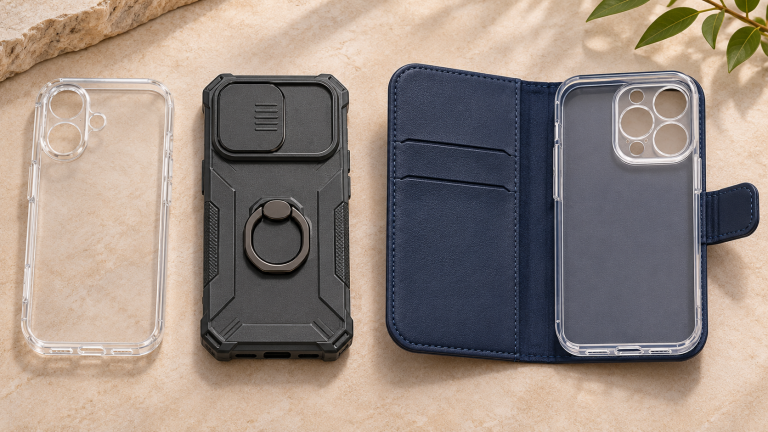
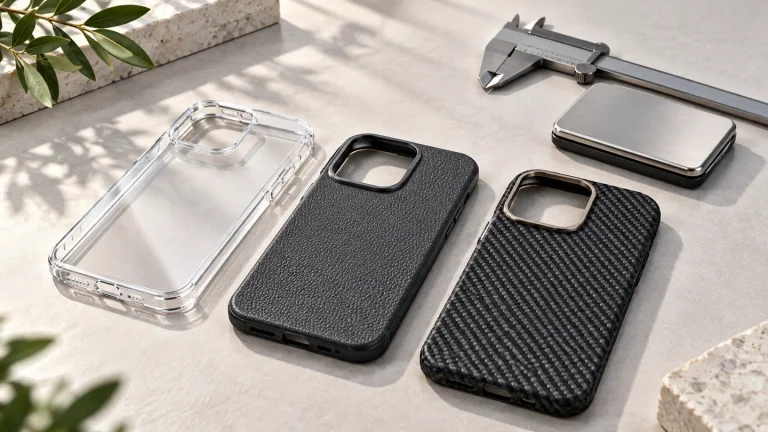
Existing products are useful when they demonstrate transferable modules, but they should not be treated as proof that the supplier already has a production-ready foldable solution. For example, Kejie’s iPhone 18 Pro Max Magnetic Kickstand Case is relevant when you ask about moving stand hardware; the iPhone 16 Clear Magnetic Shockproof Kickstand Case is useful for discussing clear materials plus magnetic and mechanical features; the iPhone 17 Custom Silicone PC Magnetic Shockproof Case gives you a starting point for questions about multi-material construction and customization; and the iPhone 17 Woven PU Leather Shockproof Case is relevant to surface and material-finishing discussions.
Then move to foldable-specific evidence. Kejie’s technical article iPhone Duo Case Design: Key Challenges for Foldable Phone Protection is a useful internal background page for defining the engineering questions — but a manufacturer still needs real DFM, sample and production evidence before you approve a foldable program.
Decision rule
Shortlist the supplier only when you can connect three things: the foldable-specific design evidence, the controlled production process, and the lot-level records that prove the production item matches the approved sample.
REFERENCE DESK
- Apple — iPhone Duo Technical Specifications
- Apple — iPhone Duo Case
- Apple — iPhone Duo Folio with Kickstand
- ISO 9001:2026 — Quality management systems — Requirements
- ISO 2859-1:2026 — Sampling procedures for inspection by attributes
Source review date: September 30, 2026. This tutorial provides a procurement framework, not a certification or endorsement of any supplier. Verify certificates, materials, test records, device compatibility and commercial terms against the exact manufacturer, facility and product you intend to order.
 English
 Español de Argentina
 Русский
 Italiano
 日本語
 한국어
 العربية
 Français
 Deutsch