
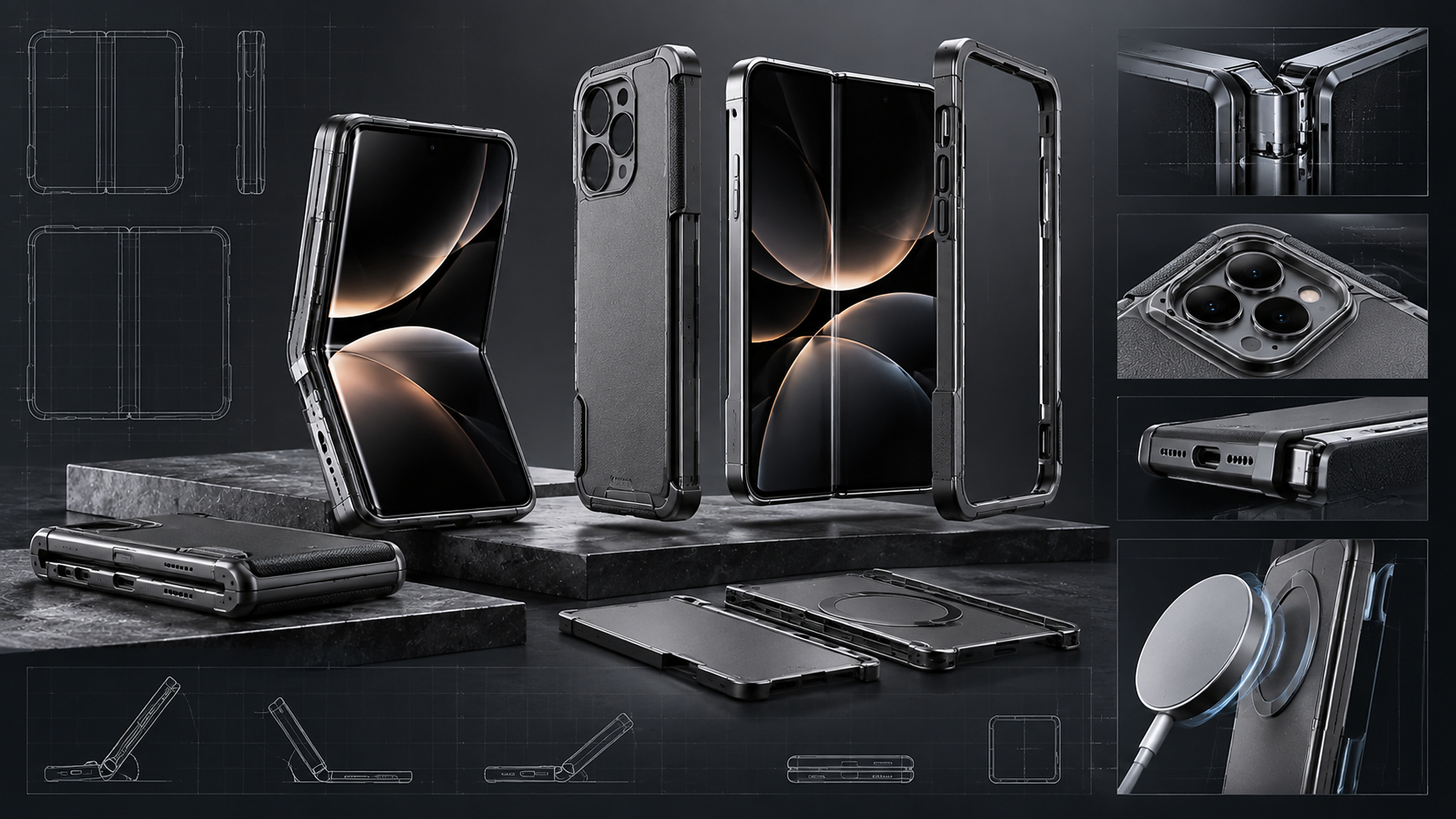
Apple’s own accessories already show two commercial directions. The iPhone Duo Case uses two shells, while the iPhone Duo Folio with Kickstand adds a viewing function. Both are described as supporting MagSafe and Qi2 charging up to 25W. This gives buyers a useful starting point: the category will compete on fit, movement, charging and use modes together.
01. A new opportunity with a different risk profile
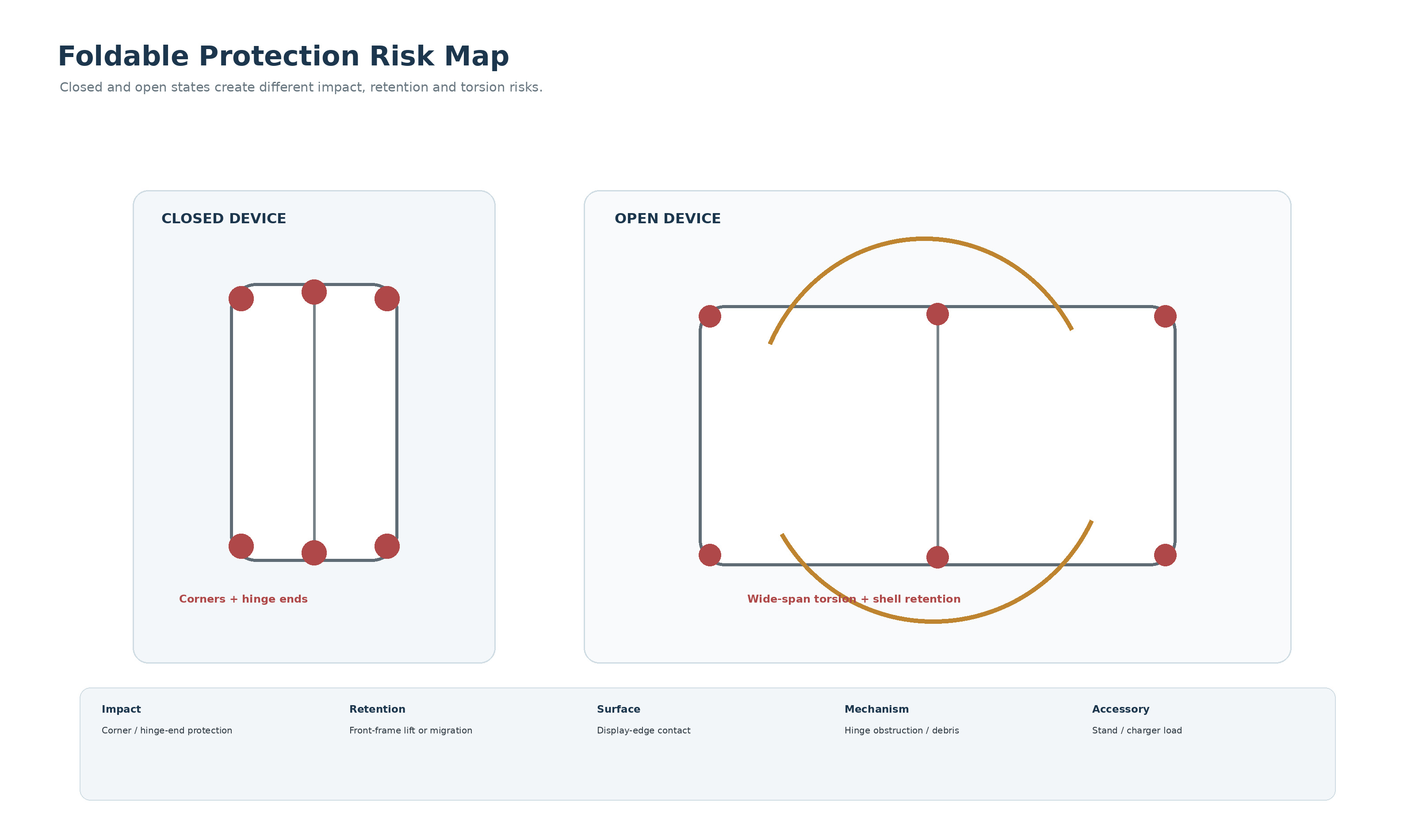
The opportunity is not simply “another iPhone case.” A foldable device can create demand for premium protection, slim two-part shells, folio systems, magnetic accessories and replacement components. It also raises the cost of a poor fit. A buyer evaluating a conventional iPhone 18 Pro Max case may focus on camera clearance, button feel and drop coverage. For Duo, the same brief must add hinge motion, front-shell retention, folded thickness, display edge clearance and repeated opening cycles.
| Buyer input | Architecture implication | Sourcing question |
|---|---|---|
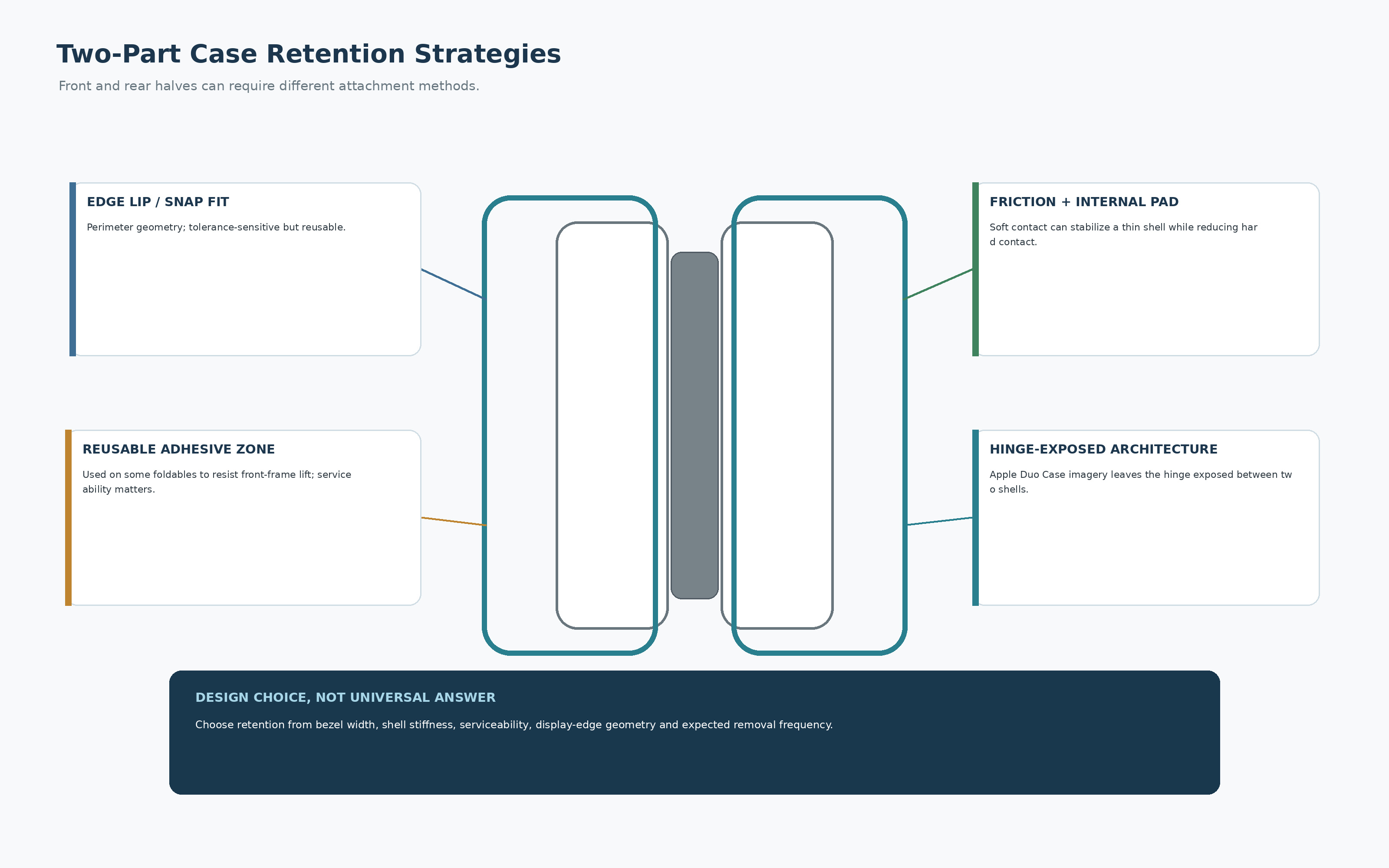
| Two displays | Front and inner surfaces need different edge treatment. | Are both shells retained without covering controls? |
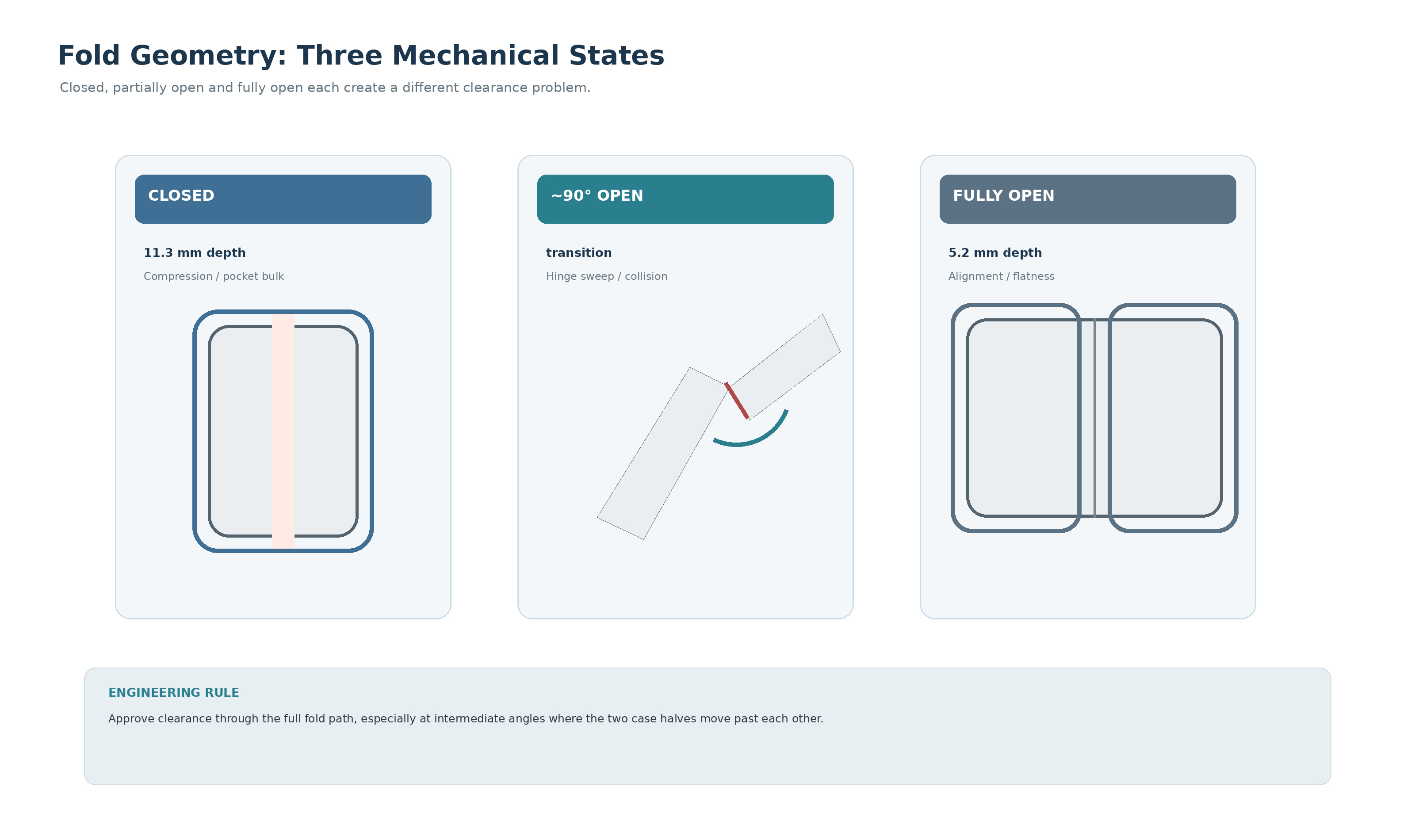
| Moving hinge | Clearance changes through the fold path. | What intermediate-angle checks are available? |
| 254 g device | Stand, adhesive or bumper carries a heavy moving product. | How is retention verified after cycles? |
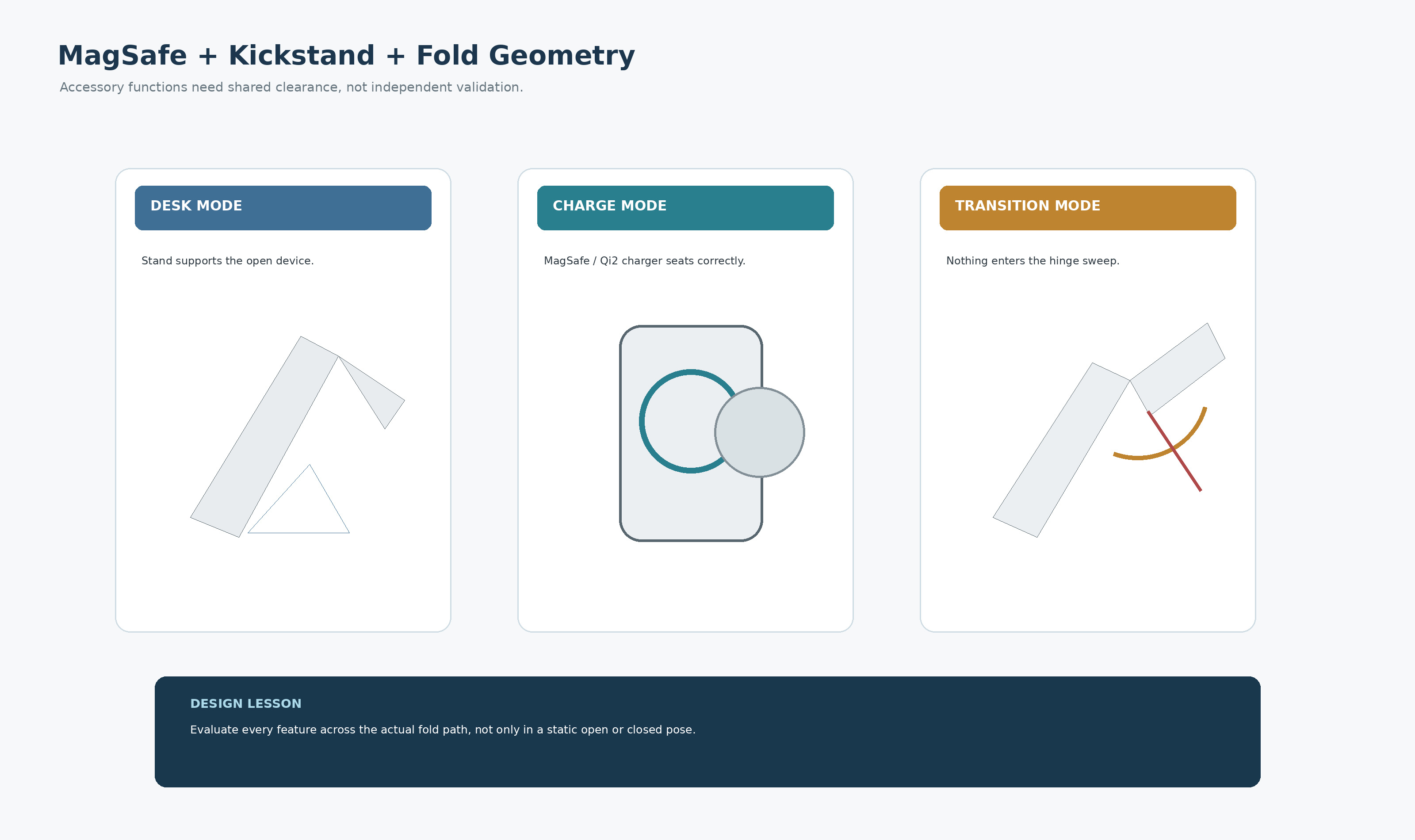
| MagSafe and Qi2 | Magnet position affects charging and handling. | Which chargers and accessories were validated? |
02. The category will split by use case
Buyers should expect at least three product directions. A minimal two-part shell can target users who want the original device feel with basic edge protection. A reinforced protective case can prioritize impact zones, hinge-area clearance and stronger retention. A folio or kickstand design can target viewing, desk use and travel. Apple’s own case lineup points to this segmentation, but it does not establish the full third-party market or guarantee demand for any one construction.
For a B2B assortment, the practical question is which use case has a clear buyer and manageable validation cost. A kickstand that works in the open state may be unstable when the device is folded. A hinge cover may improve debris protection but reduce access or create an interference point. A very slim shell may photograph well but leave little tolerance for adhesive lift or impact at the corners.
03. What buyers should verify before placing an order
A useful RFQ should ask for a device reference, shell material, retention method, hinge treatment, charging setup and validation conditions. “Compatible with iPhone Duo” is only a starting label. The approval sample should be checked on the actual device or an agreed dimensional master, with both displays active and all intended accessories installed.
- Confirm open and folded fit, including edge alignment, camera clearance, buttons and USB-C access.
- Record clearance through the complete fold path, especially intermediate angles.
- Check front and rear shell retention after repeated opening and closing.
- Test MagSafe or Qi2 charging with the specified charger and accessories.
- Record cosmetic limits, packaging protection and exact sample revision.
04. Where existing case capabilities can transfer
Some rigid-phone case modules remain useful as starting points. Kejie’s magnetic kickstand case can be reviewed as an analogue for moving hardware and magnet placement. Its clear magnetic shockproof case can inform raised-edge and transparent protection discussions. The magnetic ring-holder kickstand case is another reference for compact accessory integration. These are engineering analogues; they are not iPhone Duo products and should not be marketed as compatible without separate confirmation.
05. The commercial opportunity depends on disciplined validation
The first buyers entering this category will need speed, but speed should come from clear sample approval steps rather than skipping checks. Define the target use case, approve the dimensional reference, review the first sample in every device state, then decide whether to expand colors, materials or accessory bundles.
The best early assortment may be narrower than a conventional iPhone range. A small number of well-defined constructions can cover minimal protection, reinforced protection and viewing use cases while keeping claims and sampling manageable. Demand signals should be tracked through actual inquiries, sample requests, repeat orders and accessory attach rates rather than assumed from the launch headline alone.
Sources and buyer notes
Apple’s iPhone Duo announcement and technical specifications support the device details discussed here. Google’s Pixel Fold case guidance is comparative evidence only. Buyers should request model-specific samples and documentation before treating any claim as approved performance.
Buyer action: Prepare an iPhone Duo RFQ that names the target case architecture, fold states, charging accessories, retention method and approval checks.
 English
 Español de Argentina
 Русский
 Italiano
 日本語
 한국어
 العربية
 Français
 Deutsch